Friday, April 26, 2013

Boston Marathon Under 3 Hours: So What?

     It was sunny when I finished the Boston Marathon. I stopped my watch and walked, congratulating runners around me. After a few yards, I saw one of my running role models being interviewed by TV. It meant I, a 39-year-old amateur, had finished the race just behind Joan Benoit Samuelson, two-time Boston Marathon winner (1979 and 1983) and first female marathon runner to win an Olympic gold medal (1984). Now 55, the marathon legend is still very fast. I was overwhelmed.
     ``She's my hero, my inspiration!" I told one the photographers at the back of the media crew surrounding her.
     About an hour later, none of this mattered. Two bombs killed three people, including an 8-year-old boy, and injured more than 260 who came to support runners at the finish line.
         A week later, I still struggle with guilt when I think about the race. The mere thought of running a marathon, let alone being proud of a personal record and brush with a running celebrity, feels selfish and inappropriate.
      For months, I had conditioned my body and my mind toward a single goal, making every detail of the preparation disproportionately important. Looking back at that morning of April 15, all of those details seem pointless.
     Consider my main concerns as I woke up at 5:30 a.m.: I dreaded about being cold while waiting for the 10 a.m. start. I agonized over what kind of arm sleeves I would wear. I fretted that my watch, which had been malfunctioning, would stop working altogether. I reflected on my goals for the race, my fourth Boston Marathon, visualizing each portion of the now-familiar course. I would try to run the first half in 1h27, a pace of 6:38 a mile (14.6 km/h), leaving me just under 1h33 for the second half to cover 26.2 miles (42.2 kilometers) under three hours. The plan was ambitious -- I had broken three hours only once, a 2h59m19 in New York in 2011 -- but still within reach since my record in Boston was 3h01.
     As I walked to the school buses that would take me to the start, a bottle of water mixed with Nuun -- a self-dissolving electrolyte tab -- exploded in my bag. All of the bag's contents got drenched, including the throw-away clothes that would have kept me warm before the race. I panicked. How absurd it now sounds.
    This year my qualifying time meant that I was closer to the front runners in the corrals that help stagger the 23,000 runners' start in Hopkinton, Massachusetts. I warmed up amid runners -- mostly men -- with numbers in the 1,000s. (Mine was 2,985: in Boston, the fastest your qualifying time, the lower the number.) I remembered the words from my husband and mental coach (``Don't let it get to your head"). There was no risk: I didn't seriously think I belonged. I was just a tourist.

Feeling like a tourist among triple-digit bib numbers
       I started faster than my goal, and probably paid for it with side stitches about 5 miles into the race. Stitches are new to me: They appeared during training this year and even forced me to walk during a session of speed work -- a first. But I decided to stick with my pace of about 6:30 a mile: I was now in the race and had to give everything I could. The people of Boston, as always, carried me in moments when I contemplated quitting: the crowds cheering the U.S.'s oldest marathon, in its 117th edition this year, are like professional supporters. A lot of them have more experience cheering than we have running in Boston. That makes the attack on a group that was out for others even more heart-breaking.
     I passed the half mark in a time matching my personal best on the distance, 1h25m47, knowing that I had yet to make my biggest effort. I always tell novices that the Boston marathon starts mile 16 with the first of a series of hills. But once again, I was wrong. The hills weren't the hardest part for me -- I had trained for them. The last 5 miles of downhill following the hills were the most grueling.

The face of grueling pace
     It’s hard to describe the amount of pain I inflicted on myself as I pushed through: Everybody's threshold is different. One sign that I started to reach my limits is that I got confused about my pace. The numbers on my watch weren't adding up in my head anymore. I felt a new sensation in my legs -- they were giving way -- but I wasn't clear-headed enough to recognize it as a possible sign of lack of fuel. I had forgotten to take a last gel and drink Gatorade for a boost of sugar in the last miles, as I usually do.
     Five miles for a trained runner is easy. But for a runner in pain and distress, it's more than half an hour of digging into resources that may not be there. I was slowing down, not sure I could make it. My pace dropped to about 6:50 a mile in the last 3 miles, and about 7 minutes in the last mile. No matter how hard I tried to keep the pace, my marshmallow legs weren't responding: my torso was getting ahead of them.
     The crowd at the finish line, in wild screams, transported me. I crossed the line in 2h54m21, surrounded by cheers that would turn to terror an hour later.
    I was 55 minutes faster than at my first marathon 11 years ago in Paris, and 67th woman overall. Ten women 39 or older ran faster than I did, all but one in their early forties. The exception was Joan Benoit Samuelson, 4 minutes ahead of me. I like to pour over numbers and statistics because I can handle facts. I can't handle emotion. All I feel about my race is: so what?

Labels: , , , ,

Wednesday, October 3, 2012

Guest Blogger Angus Breaks Three in Sydney

I met Angus ten years ago, when we worked together in the London office of our company. Rain or shine (mostly rain, this being the U.K.), my teammate would show up at the office before dawn in cycling gear after biking in the dark through the streets of London. After a stint in Malaysia, Angus now works in Sydney, where he ran his first marathon in less than three hours on Sept. 16. You can tell from his report that he's a writer by trade:

``My second marathon in Kuala Lumpur in 2009 had ended badly. Fearful of dehydrating in the humidity, I drank too much electrolyte and vomited at 30km. After passing halfway in 1h30m, I walked over the line at 3h43m. Moving to Sydney that year, I knew I had to get back on the horse. It took three years.

I had always wondered how fast I could go if I devoted myself to running, so six months ago I threw myself into training. Approaching 38, I knew I might be too old to get faster, but I joined a club anyway. All in, I thought. I ran hill repeats and went to weekly track sessions, my first in 20 years. I bombarded the coach with questions, trying to find my target. I ran 3hr24m in Hong Kong in 1999. Surely I was fitter and stronger now. Should I dare to dream of three hours? Did I even have the right to talk about it?! Strange what running does to you.

And so the obsession started. I read and re-read Cécile's three-hour race report. Ninety percent mental, 10 percent training, she wrote. Not much comfort. All the same, I started to finish weekend runs at three-hour pace, wondering if it was even possible to hold it for 42km (26.2 miles). I trawled internet forums, then I bought a GPS watch and locked the racer at three-hour pace.

Secretly I doubted myself. I feared a spectacular second-half collapse, Malaysia-style. In the weeks approaching the race, I told friends I was aiming for ``close to'' three hours, even 3hr15m, scared of setting a target I'd miss. But privately, I knew I would have to try. The coach warned me the three-hour pacers might start too fast, beyond my sustainable threshold. My plan: hit halfway at 1h31m and accelerate, hoping weeks of speed work would, well, work.

And so on Sunday Sept. 16 I stood under the Sydney Harbour Bridge, the girders filtering the early morning rays. The starter said it was 13 degrees (55 degrees Fahrenheit). Perfect, if true. It felt warmer.

Angus, looking strong, passes by a famous Sydney landmark.

I put the brakes on for 10km, letting others pass me, and tried to stick to 4m19s for each km (6m56s per mile). I guessed I needed to leave something, but not too much, in the bag to give me a chance on the home stretch. I gave up a few seconds on the inclines and took them back going downhill. I was concentrating hard, running my own race.

My fiancée threw me a bottle of water and a gel at 16km, as agreed, but it stopped feeling easy shortly afterwards. The work began at about 18km, earlier than I had hoped. I passed 21km at 1hr30m30s. So far, so manageable. Losing focus several times, I dreamed of the line. I ridiculed myself for even going there!

Sydney's marathon has many loops and bends, designed to add distance without taking runners too far from the city. On one hairpin, I saw the pacers creeping away, running in the opposite direction, more than a minute ahead. I strapped myself in for some hard kilometers, clocking 4m13s pace until the 30km mark. I felt a surge of energy, before the last 9-kilometer loop that retraces itself back to the Opera House and the finish.

Now, writing this account has already been therapeutic, because I feel like I'm among friends and fellow lunatics. You guys know the score. I'm only a beginner, but I know marathon running is painful. That's our dance. Let me purge myself some more.

My body was screaming to slow down, and my mind fought to overrule it. I repeated catchphrases, threatening myself with shame if I relented. My brother had told me not to hold back. Feeling nauseous, I discarded my gel and skipped water stops.

At 35km, the two pacers were closer and I could see they had dropped most of their group. I started to crunch numbers, breaking the race into digestible chunks. With 3km to go, I was on target. I eased up, losing concentration for a few minutes. As I looked at my watch, I forgot the final 0.2km, a tiny distance that could still add almost a minute to my final time. After 40km, I entered a trance, frothing at the mouth and losing all the form gained from months of training. As I approached 42km, I knew it would be close. Driven only by obsession, I overheard a voice at the roadside telling his friend as I passed, legs and arms flailing: ``He's going to fall over.'' He was right. It felt like I was running through liquid, my legs working unevenly and independently.

Crossing the line, my legs buckled and I caught the side-barrier for support. A stranger asked if I was alright and a wheelchair appeared. I don't remember getting to the medical tent, but it took an hour of icepacks to bring down my temperature from a little over 39 degrees Celsius (102 degrees Fahrenheit), and a liter of saline in my right arm before I felt well enough to walk.

They were brilliant, the volunteer doctors and nurses. Next to me, another runner was having seizures. Someone else in the tent had run the race in thermals and had literally cooked himself. My fiancée was there. It was worth it. I had broken three hours by 28 seconds.

``It felt like I was running through liquid.'' Pain is the price to pay for a marathon under 3 hours.
As I lay on the bed, I reflected on how much the mind could push the body beyond healthy limits. I wondered where that might end, ultimately, and I felt a little guilty. But I also felt a wave of elation, just as Cecile described in her blog. Selfishly, I indulged! I felt lucky, happy and carefree! And then I swore I'd never do another. Already I'm regretting saying it.''

Labels: , , , ,

Wednesday, April 11, 2012

Creepy Somatization

And now for a musical interlude: the running song of the week is ``Creep" by Radiohead.
"I'm a creep,
I'm a weirdo,
What the hell am I doing here?
I don't belong here."

With five days left before the 2012 Boston Marathon, I suffer from shin pain in the left leg that got worse over the past week when I cut my mileage in preparation of the race. If the problem is really shin splints -- as the doctor told me it was several weeks ago -- the pain should have abated along with my tapering. It may be once again a case of severe somatization. My brain is so stressed by the race that it's ordering my body to ail. Or is it my body trying to scare my brain to avoid racing? It's creepy.
I wrote about my pre-race propensity to somatize two years ago in this blog. In the week ahead of the 2010 Boston marathon, I suffered from toenail and hip pain, as well as a sore throat. In 2006, before the Austin Marathon, it was my right shin: I couldn't walk a week before the marathon. The pain went away as if by miracle on race day.
I try to reassure myself by rethinking of symptoms before races that went well. The day before the 2011 New York City Marathon (a personal record), my stomach was cramping and I felt weak. The day before a half-marathon in Wilmington three weeks ago (also a personal record), I felt exhausted and my left shin was hurting.
How can I know whether the pain derives from a real problem in my leg, or is just evidence that I'm a weirdo? I try to be rational and evaluate the symptoms: the shin pain is acute at times and very localized -- possible signs of a stress fracture. But the pain doesn't radiate across the bone and the leg doesn't feel weak, as it would do in case of a stress fracture. And, weirdly, the pain goes away when I run very fast (I guess I know what to do on race day.)

My somatization history shows that I won't learn any lesson whether I have a great race or do not finish. Mystery ailments have evaporated on race day in the past, and I also know how real injuries feel like because I've suffered from so many. But in the days leading to a race, I lose my rational mind and can't tell them apart.

The only other runner I know who somatizes as badly as I do is my mother, who gets pre-race sore throat and fever: It must be a hereditary disease.

Labels: , , , , ,

Thursday, December 22, 2011

`How Far Would You Go to Run a Marathon?'

``I signed up this weekend for a marathon on September 18th 10K miles away,'' my friend and colleague Craig told me in an e-mail on Aug. 8. ``Can you guess where?''
Craig travelled 10,000 miles from New York to Sydney to run a 26.2-mile race after a 24-hour trip and training truncated by a hurricane to two weeks. With a 16-hour jet lag and heat that rose as high as 83 degrees Fahrenheit (28 degrees Celsius), Craig, who describes himself as ``not a warm-weather runner,'' ran a slower-than-usual 4h55m: he walked during the final 6 miles to avoid becoming a casualty of the heat and not finishing.
``I was very happy when Sydney was done since it was not pleasant from the start,'' says Craig, who stayed in Sydney for four days.

On paper, the trip's return on investment is negative in terms of pain, time spent, financial cost and perhaps mental sanity. Yet for Craig, who has a ``grand plan'' of running a marathon on every continent, it was important to cross Oceania off the list. His determination gets my respect, regardless of whether you deem the last-minute Sydney decision a folly.

(Craig at the Sydney Marathon 2011, where organizers set up tables with large dispensers of suntan lotion and handed out hats to beat the heat.)

Craig, who ran his ninth New York City Marathon seven weeks after Sydney, says he's known as ``the guy who runs in every marathon.'' He has inspired a colleague in New York who had stopped exercising to become a triathlete and has inspired many others.

His vow to run a marathon on every continent came after seeing Ranulph Fiennes, a British adventurer and endurance runner, at the finish of the 2003 New York City Marathon. Fiennes, who was 59 at the time, was ending his challenge of seven marathons in seven days on seven continents, four months after undergoing a double heart bypass operation. The two finished the race within a minute of each other and Craig commented on Fiennes' Union Jack shorts, realizing only later to whom he was talking.
``I could not believe he was doing this,'' Craig says. ``I have a lot of respect for him."

Craig's list of marathons now spans six continents, in cities including Chicago, London, Paris, Tokyo and Austin, Texas; one amusement park: the ``Goofy Challenge" at Disney World in Orlando, Florida, a world of its own; and the end of the world -- the Fin del Mundo in Ushuaia, Argentina. His best memory was the Antartica Marathon in 2005, ``primarily because I was locked up with 100 crazy runners for 10 days,'' he says.
``Anytime that they offered something to do, there were 100 folks ready to do anything -- camping, swimming, kayaking, climb up a mountain, etc.,'' Craig says, adding he was intimidated about being among top runners.
Hanging out with the elite may have helped him push his limits. Antartica was the only marathon where he kept feeling strong until the end, he says.

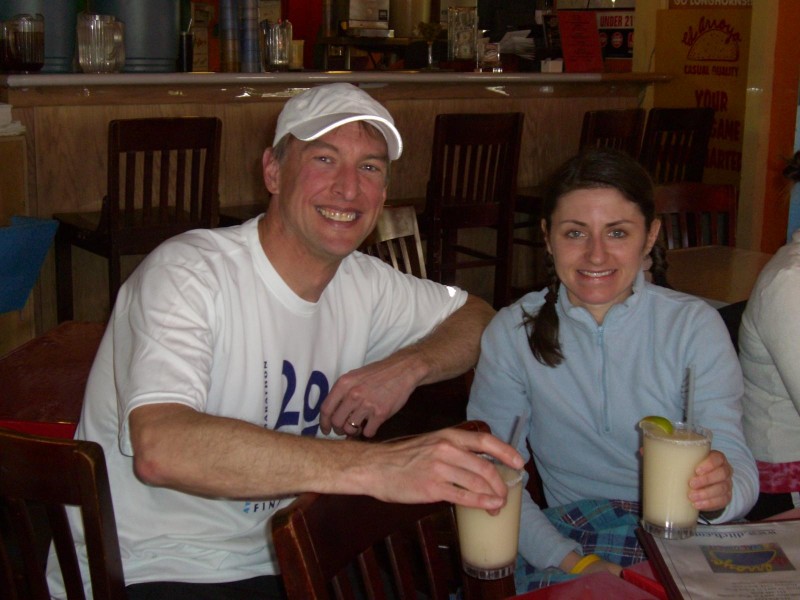
(Frozen margaritas are the best post-marathon recovery drinks. In Austin 2007, where we both had personal records. His still stands.)

Craig's rationale for booking a trip to Sydney just a month ahead from the race is surprisingly rational. In August, Craig had run only two marathons since breaking his ankle in early 2009 by falling on ice, an injury that left him unsure about how long he could continue running and put his grand plan on hold. He participated in the New York Marathon ten months after the injury, a race he describes for obvious reasons as a ``bad experience." Running New York 2010, a year after getting corrective surgery, felt like a turning point, he says, giving him some confidence that he'd be able to continue running . For 2011, he turned his sights to Australia, where he considered Sydney and Gold Coast in July.
``The timing worked out this year for doing Sydney, so I went for it," Craig says.
Two weeks after he booked the flight, Hurricane Irene struck, flooding his basement and leaving him without power for six days.
``That was basically the end of my training for the marathon," he says.
Craig, who started running in junior high school, ran his fastest marathon in Austin in 2007, four years after his first try at the distance at age 45.
``Running was always something I enjoyed but never really pushed myself at it until recently,'' he says.

Craig won't stop after he's done with his grand plan. He just turned 50, entering a new age category, and hopes to improve his time enough to qualify for the Boston Marathon.
In the meantime, for the last continent on the list, Africa, Craig is considering the Kilimanjaro Marathon in Tanzania or South Africa. That's about 8,000 miles away from home.

How far would you, or have you gone, to run a marathon? Runners, you can let me know in the comments section.

Labels: , , , , ,

Wednesday, May 18, 2011

`Go Melissa, She's Dying!' Losing a Sprint at the Pocono Marathon

I've always felt bad for athletes who come fourth at the Olympics: I'd rather be fifth or even tenth. So last Sunday at the Pocono marathon, I had a golden opportunity to feel sorry for myself.

After running in third position for more than three quarters of the race, I was caught by a female runner as I approached the stadium. The odds were against me for a sprint: she was coming faster and she was about 10 years younger.
Her husband ran toward us, screaming ``Go Melissa! You can do it Melissa!'' When I saw the finish line's banner, I made a desperate attempt to push up the pace. But I knew I was doomed. She was still right behind me when we entered the stadium, with 200 yards (200 meters) to go, and her husband wasn't giving up either: he ran across the football field, took a good look at me and said: ``Go Melissa, she's dying!'' The truth hurts when screamed right in your face. She passed me and I finished fourth, four seconds behind her. I found out later that her husband, Justin, had finished the race about 30 minutes earlier in fourth place -- I admit it's hard for me to feel too bad for him.

(Dying to get to the finish, knee first.)

The drama at the finish line overshadowed the fact that I ran my fastest marathon ever (19 seconds faster than my previous personal record, or PR), after a truncated training of one month, rather than the three it usually takes. A month earlier, I didn't even know I would be running a marathon.

On April 18, I wasn't able to participate in the Boston Marathon because a calf injury mid-January forced me to cut my mileage to a minimum for more than two months. By April, my calf had recovered, but not soon enough to train for a 26.2 mile (42.2 kilometer) race. One of my last chances to qualify for Boston 2012 was the Run for the Red Marathon in Stroudsburg on May 15, a downhill race in rustic northeast Pennsylvania, about two hours from home by car.
I downloaded a one-month training plan from Runner's World magazine's online tool SmartCoach. The plan called for four runs a week, with a weekly long run of no more than 16 miles. It seemed really light to train for a marathon.

The SmartCoach tool was co-created by Amby Burfoot, the 1968 Boston Marathon winner and an editor-at-large at Runner's World. In a message posted on the magazine's forum, I told Burfoot about my injury and low mileage, and asked him whether it was realistic for me to get ready for a marathon in a month with that plan. He said that because I had a limited amount of time left, running for more than 16 miles would increase the risk of injury.
``I personally believe that 16 is plenty for a marathon, provided you pace yourself right on race day. That's always the key. I don't think you can expect a PR with your somewhat limited training,'' Burfoot wrote back. ``I suggest under-training at this point. You've gone the marathon distance before. You know you can do it. Best wishes."
My friend Tomas told me that before his record marathon in 2h59 last year, he only ran one 18 miler at a fast pace and otherwise didn't go longer than a half-marathon.
They convinced me that shorter can be better. I started following the SmartCoach plan, with some adjustments: I ran five times a week instead of four, and my last two long runs were 17.5 miles, including 5 miles on trails.

I registered 10 days before the race. After a short night -- my hotel room was above an Irish Pub that blasted music until 2 a.m. -- I lined up at the start along with about 800 runners, including fellow members of my local club, the Delco Road Runners Club. I felt uneasy about being rather unprepared and hopeful that the amount of cross-training I had done while injured would compensate for the lack of runs. On my left was a blond with a pink top who looked like a very fast runner (Olga Dedova, from Russia, came first female).
We started in the fog and drizzle on deserted roads through the woods of the Pocono mountains. A woman who looked to be in her forties passed me after a few miles: from the back of her, I could tell I would probably not see her again (Conni Grace, 48, finished second). It was still early in the race and I concentrated on finding my own rhythm. After a few more miles, I caught up with two women and passed them: one was wearing a blue skirt, and the other was dressed like a triathlete: black sports bra, black shorts and her first name painted in black on her forearms. Both looked in their 20s or early 30s.
My watch stopped working after about 6 miles. I caught up with two tall men who were discussing their splits.
``6:49 a mile: We're on pace for a sub-3,'' one said, meaning a marathon in less than 3 hours.
Was I going too fast? I was feeling good, so I decided to keep the pace and stay with a group of about six men, including a young runner in an orange shirt.
When the only clock on the race showed 1h28 for the half-marathon, I knew I was going a little faster than a year ago in Boston. I also knew that the worst was yet to come and that I should enjoy the cheers from the little crowd.

(Looking good at the half marathon, with my bodyguards.)

After mile 18, our group scattered and the real suffering started: for the rest of the race, I would run mostly alone, without any notion of my pace, and very few spectators to boost my morale. Pain in my left quad reached a level of discomfort I could no longer ignore. I was just hoping it would hold until the end. Running downhill through rolling hills is a great experience over 5 or 10 kilometers. It's a lot harder over 20 or more. My stomach, too, was painful. I kept going, bolstered by the few spectators who screamed ``third woman!" I made a point of never looking back.
I ran out of steam over the last 6 miles and I wasn't alone. I caught up to the man in the orange shirt: he looked in distress. As I passed him, I tried to encourage him to come with me: ``Come on, let's go!'' I could have used some company, but he didn't follow.
As I reached the arrival town of Stroudsburg, I was hoping the crowd would help me through the last two miles. But no one seemed to care. People were going with their business, not really paying attention. In a couple of instances I wasn't even sure where to go: there was no clear sign and no runner in front of me. I felt disoriented. I took a turn to the school's parking lot -- along with a couple of cars -- and as I was about to make another turn, I heard spectators screaming ``Straight! Straight! Between the buses!" I turned my head and I saw Melissa Gillette, the girl with the blue skirt. I screamed an expletive in English -- which may be the ultimate proof that English comes really naturally to me now -- and headed towards the stadium, Melissa in tow. As she passed me, I felt frustration and disappointment. But as I approached the finish, I was in for a nice surprise: the clock showed I had a new PR of 3h01m24, proving Amby Burfoot wrong by shaving 19 seconds off my previous record. Every second counts.

(Consolation prize: first in my age group and a picture with the organizers.)

Labels: , , , , ,

Wednesday, January 26, 2011

A Tempo For K

Three weeks ago, I talked to my friend K, who's been suffering from seizures for almost 11 years. She got out of another stint at the hospital just before Christmas after two months, including 10 days during which she went into what she described as violent, constant fits on her entire right side. She was bedridden and at some points couldn't talk.
``We're talking 24/7,'' she wrote. When the seizures finally stopped, they left her temporarily paralyzed on the right side and in need of physiotherapy.
When I told her that she's been dealing with the ordeal with an exceptional courage, she answered: ``You just kind of deal with things as they happen because you can't do anything else. Ultimately, I think it makes you a stronger person.''

Shortly before we had this exchange, I was thinking of the workout I had scheduled for that night. For the fourth year in a row, the new year marked the official start of my training for the Boston Marathon, and on my program that day, Jan. 6, was my first tempo run: 2 miles of warming up followed by 5 miles (8 kilometers) at a fast pace.
I dreaded the exercise because I had to use a treadmill, which I find a lot more difficult -- and boring -- than running outdoors. I was certain I couldn't sustain the pace for 5 miles, maybe not even one: I'd never done it before on a treadmill, even during my previous marathon trainings. I was toying with the idea of pushing back that workout to the following day, not that it would make it easier since it would still have to be on a treadmill -- just a day later. I was being a typical self-centered, insecure runner in marathon-training mood. I was preoccupied by minute details of my training plan and how to fit it into my day.

Talking to K reminded me how lucky I am to be healthy. I reluctantly headed to the gym after work. When I saw that all the running machines were taken (by the new year resolution crew), I was both angry and relieved: I wouldn't have to do that grueling workout after all. The second I finished that thought, the man on the last machine in the corner of the room finished his exercise, leaving me with no excuse.
I had K on my mind when I pushed the start button for the 2-mile warm up and Radiohead on my iPod. I faced a window covered with steam, through which I could only see lights from cars and traffic signals (green-orange-red; green-orange-red; green-orange-red). I started very slow, at 6 miles an hour, and gradually increased the speed every minute, by 0.1 mile for the first 10 minutes and 0.2 mile after that. When I reached 2 miles, I was just above 8 miles an hour, and that pace felt fast. Now I had to increase it to 9.2 miles an hour (or about 6:31 a mile) and sustain it for about 33 minutes to complete the planned workout: It seemed unfeasible.
I started at 9.1 miles (6:35 a mile), feeling like a wimp for being 0.1 mile slower than the required pace, and it felt like a sprint. I was trying not to look at the dashboard. After staring at the blurred traffic lights for what seemed like an eternity I couldn't resist checking the mileage: 2.38 miles. Great: I had run 0.38 miles out of the 5 miles requested. That's when Radiohead helped: the song ``Street Spirit (Fade Out),'' from The Bends album, gets me in a trance. At the end, I hit the rewind button again and again. I also decided that 9.2 miles an hour wouldn't be much worse than 9.1 miles so I increased the speed.

After 2 miles -- the equivalent of about three times ``Street Spirit (Fade Out)'' -- I started to think I might be able to complete the workout. Milestones are important for geeks like me during a workout: a quarter, a third, half. The most difficult part of a treadmill session is the first 20 minutes. Sometimes when I reach 0.5 mile of, say, a 7-mile session, I think to myself: 13 times of what I just did and I'm done!
With about 1 mile left -- by now I'd listened to ``Street Spirit (Fade Out)'' about six times in a row -- I went bold and increased the speed one more notch to 9.3 miles an hour.
K was still on my mind when I reached 5 miles, satisfied with my small accomplishment, meaningful only to myself. She was my inspiration.

Labels: , ,

Wednesday, November 17, 2010

Why We Run

At 7:33 a.m. last Sunday, my father sent me a text message -- ``Maman 3h56 moi 3h46'' -- announcing my mother's and his time at the Nice marathon in the south of France that morning. My program for the day was to run to the local park to compete in a 10-mile trail race and run back, for a total of about 21 miles. With hindsight, my plan to run long that day wasn't a coincidence.

For his book ``De Rennende Hollander'' (``The Running Dutchman,'' published in Dutch last month and hopefully soon available in English), my friend D. asked fellow runners including me a simple question: Why do you run? My answer concluded this way: ``It’s like asking me why I breathe: I just do. It’s part of me. Maybe I run because my parents run, quite simply.''

It's difficult not to be inspired by parents who not only run competitively at age 62 and 63, but also do it in the most unassuming way. I got the chance to train with them for two weeks in September, while they were visiting me in the U.S. They stuck to their training plan -- for a 3h45 finish time -- even through downpours. They followed each run with 30 minutes to an hour session of stretching, abs and core exercise.

(``Let's go running in the rain!'' The Daurat stick to their training plan. Simone borrows a Phillies hat that matches her outfit.)

My parents, who started running in their mid-30s, are as driven as they ever have been: Perhaps more so now that they've both retired.
My mother got sick with a sore throat during her visit and took one day off running. The following day, while she was still feeling poorly, she accompanied my father and me to the park, where we would run his so-called tempo run of the day (6 miles including about 4 miles of progressive acceleration). She said she would walk. About 20 minutes later, I left my father and ran back to my mother to tell her where he planned to go. I saw her before she saw me. She was jogging: I knew she would.
My father kept track of all his runs thanks to his Garmin watch, which gives him distance and speed, among other data. Every day, I would pick roads that would fit their training plan and accompany them. On a day that called for an easy run of 10 kilometers (6.2 miles), I elected for a road I'd never tried myself. When we arrived at what I had chosen as the return point, my father looked at his watch and said: ``It's only 4.8 kilometers, let's continue a bit more: an easy run has to be 10 km. I'd rather make it longer than shorter.''

Sunday was my father's 19th marathon and my mother's 17th, and their time 1 minute faster than in the text message after checking their real time online. As rigorous and motivated as they are in their training, they're also realistic. My mother was disappointed by her time, 7 minutes slower than last year. She says she peaked two weeks too soon. Four days before the race, she also caught a bad cold that floored her. My father says he was happy, even though he secretly hoped to do better than last year (he was 2 minutes slower). Both tell me they don't push as hard as they used to. They're content to still be running. Hours after the race, my mother said she didn't know whether she'll do it again. Two days later, she said she might do three more to round up to 20.
``It's a nice number,'' she said. She says she'll stop when she doesn't want to run anymore, when the desire is gone. Clearly, it isn't.

(The Daurat, enjoying a post-club run slice of watermelon on a warm September night, pose with Delco RRC's Byron.)

On Sunday, after texting back to my father that I was proud of them both, I ran to my own race. I had no particular expectation, except having a good time on the trails, enjoy the beautiful weather and log in a 20-plus mile run.
I arrived just in time before the registration ended, signing up at the same time as two tall, blonde women who looked very strong: I was relieved when I heard they would run the 5-mile race, not 10 miles like me.
The 200-runner race started nicely, on an easy path patted with fallen leaves, but soon turned technical, to my disadvantage. Even though I felt like I was at my maximum speed on the steep downhill -- the skin of my cheeks flopping at each step -- I got passed by runners: only males, to my relief. After taking advantage of a small hill to pass a couple of women, I moved behind one of the two blonde women I'd spotted at the start. She was going at about my pace. I stayed behind: in the back of my mind there was a little voice that called me a slacker for not trying to pass -- just because I knew she wouldn't compete in the two-loop race. The second part of the 5-mile loop was very steep and around mile 3, I managed to pass her.

At mile 4 or so, one of the female volunteers said: ``That's what I wanted to see! First female!'' I finished the first loop in first place and set up for the second loop, not knowing who was behind me, or how close. I couldn't see anyone ahead of me either: Was I alone? On the steep downhill, I came across runners who were making their way up toward the end of their first loop. I got distracted, tumbled, fell (on my face, literally, as I had to remove dirt from my right eye), got back up on my feet with surprisingly limited damage and continued right ahead.
After a short moment, I heard: ``Wrong turn! Wrong turn!'' I had to go back up. Two men who were behind me were now ahead. I had no idea where the next woman was. The second portion of the loop felt much harder than the first time. My thighs were burning. I reminded myself that it was also hard for the others. Twice, I had to stop for a second to recover. The man just ahead of me was now walking uphill: I passed him. ``Hey, but you were ahead of me before!,'' he said. In fact, it turned out that at a few other runners had also missed the turn and, unlike me, only realized it once at the bottom of the slope. I'd lost just a few seconds.

I crossed the finish line as first female, ninth overall and got a nice trophy. I ran back home with the trophy in my hand, smiling to myself at the thought of how ridiculous I must have looked. It's the second time in four months that I won a local trail race. Winning is fun. But that's not why I run.

 (Bringing home my trophy. Merci papa, merci maman.)

Labels: , , , , , ,

Thursday, November 6, 2008

Faster Than Yannick Noah

My parents beat Yannick Noah, 48, the 1983 winner of the French Open, at the New York City Marathon this year. Too bad the word awesome is overused because it applies to them. My parents are in their early 60s. They inspire awe.


``I'm happy with my time,'' my father, 60, said after the Nov. 2 race, his 16th marathon. He was wearing a navy blue, hooded sweat-shirt with ``France'' written on it. He had a big smile on his face. My father finished in 3h37m45s, his best time since 2004, ranking 45th out of 910 men aged 60 to 64. The previous afternoon, nursing a beer in an Irish pub near Penn Station, my father said he would be disappointed if he ran in more than 3h50 and happy if he could go under 3h45.

``It's not bad, I'm just a bit disappointed because I walked near the end.''
That's my mother, 61, standing next to her husband after the race, wearing the same shirt. She completed her 15th marathon in 3h53m32s, 8th of the 216 women in her category, and shaved 5 minutes off her time at last year's New York marathon. ``I can still scrape off few minutes while being one year older!'' she said. At the pub the previous day, she said she would ``explode with joy'' if she could finish in 3h50.

My parents are unaware they are awesome, not just because of their athletic feat, but because of their modesty and the apparent simplicity with which they tackle such a challenge as a marathon. They don't brag. They don't complain. They don't find excuses when their time is disappointing.

Their secret for doing so well this year, they told me, lay in the preparation. For the first time, they chose a training plan -- a strenuous program for a 3h30 race that included speed work on various distances -- and strictly followed it. They also worked on their core. Another change from previous marathons was that they drank water and Gatorade more regularly and took energy gels during the race.

In my father's case, it helped that he was training during the week with a friend who runs faster than him. In my mother's case, it helped that she retired and had time to train. The plan helped them recover faster too. By Nov. 5, any minor sore muscles they'd had were gone. I suspect most of the soreness was due to the flight back home on Nov. 3, rather than the race.

My father said he tried to keep his pace in the second half. In fact, he ran a bit faster from 35k to 40k (27m33s) than from 30k to 35k (27m37s).
``Trying to keep the same pace, avoiding slowing down -- that's the only way to finish,'' he said. ``It's very tempting to say `I'll just slow down a little bit now and pick up later when I feel better,' but it doesn't work. You never pick up.''
My parents work out all year, not just to prepare their marathons. In the winter, they run and take bi-weekly gym classes -- which include abs, stretching and leg work. They bicycle up mountain passes during the summer. Every year in July, they take a two-week vacation bicycling all day from a hotel to another with a large group of friends. That explains why, when they begin their marathon training, they start off from a good base.


Last Sunday after the race, my father was sitting on a bench on Central Park West, busily texting his running partner, and my mother was looking for something in her bag, when the 6-feet-3 (1m93) Yannick Noah walked by. The former champion, who is now a popular pop singer in our country, had just finished his race in 4h00m33s. By the time I'd told my parents to look up, Noah was already several meters away. ``Yannick! Yannick!,'' my mother screamed. The former tennis player didn't look back. If he had, he would have seen two champions who ran faster than he did.

Labels: , , , , , ,

Thursday, October 2, 2008

A Day for Books and Socks

I'm reading ``What I Talk About When I talk About Running,'' by the novelist Haruki Murakami, a gift from D., my friend and running partner in New York City, and from J., my friend and former boss. Even though Murakami and I are of different age, sex and country, and even though we came to running for different reasons, I find myself nodding every other page at a statement or an anecdote, thinking: ``Yes! Me too!'' There is a common ground to runners that I haven't found in other parts of life. My love for cycling is as great as my love for running, but when I talk with fellow cyclists, it's usually about how a ride went or what the next ride will be like. It's stories about having a flat, changing gears or falling. It's about hills and slope percentages (``I did a 12 percent. It was tough.'') Runners' conversations, in my experience, are more visceral, especially as far as long-distance runners are concerned. Our body is the machine, so it's about muscle, bones, sweat, blood, blisters and bladders. We share a visceral common ground.

Today is a beautiful day on Cape Cod, sunny and about 63 degrees Fahrenheit (17 degrees Celsius), and I'm inside, reading, wearing warm socks.


I'm not outside because I did something I think most runners will understand, because they've done it too. I ignored the signals and thought I could get away with a sore throat. As a runner, I'm trained to push my body to its limits even if it tells me it's in pain. That mental discipline is the only way to finish a race or a run. Yesterday, when I woke up with a throat on fire (due to my running in the rain two days earlier), I decided to have a ``make or break'' run. I believe, or perhaps make myself believe, that sometimes a good sweat is the best cure to the beginning of an illness. It has worked for me in the past. Not yesterday. I took my camera and went to the Priscilla Lane town landing, on the other side Nauset Harbor's Mill Pond, which I visited earlier this week. I was glad I did because it was beautiful. I felt a bit cold at the beginning of the run, but the sun broke through from time to time to warm me, and even though my throat felt dry and painful, the rest of my body enjoyed the run. I ran 10.3 miles (16.6 km) and I felt like I could have continued for much longer if my throat hadn't been so painful.


This morning, I woke up with a full-blown cold. Ignoring a sore throat isn't too dangerous. I'm staying home today, reading about running and hoping to be back in shape tomorrow for a bike ride. Sometimes, runners ignore much larger problems and avoid consulting until the pain is unbearable, because there's nothing worse than hearing from a doctor: ``You have to stop running immediately.'' During a marathon, I need to force myself through pain and discouragement: giving up isn't an option. To finish a marathon, a runner must ignore her body when it says, ``You have to stop running immediately.'' After training my brain not to give up, I have a hard time being reasonable and stopping before it's too late. It seems it's an inherent part of me, as a runner.

Labels: , , , , , ,