Friday, March 15, 2013

What's Wrong With Hermitic Training?


This year I trained almost exclusively on my own for the Boston Marathon: no club run, no competitive races and no one but myself on the long runs. It wasn't by design but the result of a litany of excuses, including poor planning, working long hours, post-work appointments, sleeping in and the flu. As the weeks passed, it became obvious my training was flawed. I decided to make it part of the game, as a test: Can I run a successful race after a mostly solitary training?

(Can you spot me training near St. Lichaa hermitage? Photo credit: Guillaume Piolle.).
Running a marathon is by definition an individual pursuit: You'll be on your own the day of the race anyway, said my massage therapist, a former professional female triathlete who still completes Ironman events in under 11 hours. True, but on race day I'll be surrounded by thousands of others who will inspire me to surpass myself. The same goes for training: running with better runners is the best way to get faster. That's why I always urge fellow runners to incorporate races into training, ranging from 5Ks to half marathons.

Races are more fun than trying to run fast on your own, especially on a treadmill, a torture device that is essential to my weekday speed sessions during the winter. They are also a good opportunity to get used to prestart jitters, to hone strategies and to fail: It's better to be disappointed by a training race than the race itself.
(Torture center with view, down in the basement.)
I kick-started the training for my past two Boston marathons with a 10 mile (16 km) race in Wilmington in January. The race, hilly and appropriately named "Icicle," is a great gauge for evaluating where I stand in terms of pace and a chance to grab a little award for my age group -- a morale booster. The race is about three months before the Boston Marathon so, even if I don't perform well (I ran 2010 at a slower pace than my eventual marathon), I know I have plenty of time left to progress.

This year I missed the Icicle race because of the flu, which grounded me for 10 days. The only other race I'd scheduled was a local 5K fun run, which I incorporated in the middle of a 20-miler. My plan was to get out of my comfort zone on a distance I'm not very good at by trying to follow the leaders as long as I could. It panned out when the fast 20-somethings apparently stayed home on that snowy day. After about 500 meters I was alone in front and stayed there for the rest of the distance.

Small local races can be very fast or very slow, depending on who shows up. I could have run a few more since. But I didn't: There was always an excuse.

Back in 2010, I wrote how running with the Delco RoadRunners Club helped me get back to running after a long illness and win my first award in a New York City half-marathon. Two months later, I ran the Boston Marathon in 3h01m43, a personal record at the time. There's a lesson here: Camaraderie makes you run faster. I see it as almost vital during training: talking about running gets some of the steam off my obsessive-compulsive mind.

It's good to be able to share stories that would bore non-runners to death. Most runners are over-sharers: we love to talk about our pace, injuries, pains, training strategies, types of shoes/socks, chafing and bowel movements. We have no shame. This year, I was unable to join my club on weekdays. I kept my insecurities about my training flaws mostly to myself. My husband has suffered the collateral damage of my lack of socializing with other workers. I try not to burden him with tedious tales of my runs, but I often can't help. Before he can utter the question "How was your run, honey,?" he usually already knows my pace, whether I'm happy about it, which muscles hurt and a few other details. 

I keep going back to my training log for the 2011 New York Marathon, the only time I finished under 3 hours. I check my pace and weekly mileage and inevitably find that my current training is inadequate for a repeat. But I like one entry: a half-marathon on Oct. 15, 2011. I ran it in a disappointing 1h30. Four weeks later, in New York, I ran the first half of the marathon in 1h27 and finished in 2h59m18. When I feel bad about my training, that log entry is like a chocolate bar.

With four weeks left before the race, I can't undo the wrongs. I continue to doggedly, solitarily follow my training plan. My speedwork has consisted of uninspired sessions on my basement's treadmill. I feel like I butchered them. I was often so tired after a day of work (I'm at my desk at 6:40 a.m., so no time for exercising before work) that I postponed those sessions day after day, until there was only Saturday left to do them. It is another quirk in my training this year: I would not recommend speedwork and tempo runs the day before a long run (which I usually do on Sundays). Those sessions belong to midweek.


Perhaps I got a few things right. I ran my long runs faster than I used to. They're no longer 20 milers. They are 20 one-milers, and in each I try keep a steady pace. My last long run of 21 miles averaged 7:04 a mile, which is "only" 12 seconds slower than the pace I would need to finish in 2h59m59. It restored some of my confidence. Not a lot.

Next Sunday will be the end of my hermitic experience: I'll be running a half-marathon in Wilmington with my club. The course -- downhill followed long uphill -- makes it a mini version of Boston's. I always use it as a dress rehearsal, perfectly timed four weeks before the race. This year it will be a public test of my private training. 

Labels: , , , , , , ,

Friday, March 16, 2012

Hunting the Great White Whale: A Sub-3 Boston Marathon

     ``Oh! Ahab," cried Starbuck, ``not too late is it, even now, the third day, to desist. See! Moby Dick seeks thee not. It is thou, thou, that madly seekest him!''
                                -- Herman Melville, Moby Dick

     With a month left before the 2012 Boston Marathon, I am chasing a pointless yet irresistible target: running the race under three hours. The goal is forcing itself upon me because I ran New York City in 2h59m19 four months ago, my first so-called sub-3. Yet there's no obligation and no obvious reward in this hunt. I am pursuing my personal record: It is I, I, that madly seekest it.
     Unlike Captain Ahab in the Herman Melville novel, I'm not seeking revenge against a gigantic white sperm whale that destroyed my boat and ate part of my leg. But I share a similar stubbornness, if not rage, in the pursuit; it's the Captain Ahab in every marathon runner. The only way to endure self-inflicted pain for 26.2 miles (and months of preparation) is to be consumed by a sometime destructive drive toward a single goal. Like Ahab, we also ignore the sage advice of the Starbucks in our lives and make ill-fated decisions.
     "Are you ready for your race?"
     "No."
     This year, as usual, I feel unprepared for the marathon. The litany of my training's flaws is endless. I incorporated too few races, such as 5-kilometer or 10-kilometer races, which are more efficient than regular training runs. I worked too hard on my speed and tore a hamstring muscle in January: as a result, I couldn't work hard enough on my speed in the two following months. I ran too many times alone on a treadmill, without the comforting companionship and friendly competition of fellow runners. I may have run my long runs -- 20 miles or so -- too fast, and as a result I may be peaking too soon. I developed shin splint on my left leg and failed to give it proper rest to heal.
     I'm familiar with the hilly course after running Boston in 2008 and 2010. What's required to achieve a sub-3 there is simple and frightening. I would need to run the first half in 1h27 or less, matching or beating my personal record on the distance (established, ironically, during the New York City Marathon). On the second half, uphill portion, I would need to run a pace 7 minutes a mile or less: that's about 20-30 seconds faster than my training runs. Like in New York, I would need to run full out for three hours.
     Regardless the challenges, I'm doggedly following my training plan. The sad truth is -- and this is hard to admit to myself let alone write for public consumption -- I might only be satisfied with 2h59m18.
     With so much energy spent toward a single goal, it's hard to recognize satisfaction -- short of the goal itself. I need to learn from Moby Dick. Captain Ahad didn't survive his fateful chase of the great white whale, and that's where I want the analogy to end.


Labels: , , , ,

Thursday, December 22, 2011

`How Far Would You Go to Run a Marathon?'

``I signed up this weekend for a marathon on September 18th 10K miles away,'' my friend and colleague Craig told me in an e-mail on Aug. 8. ``Can you guess where?''
Craig travelled 10,000 miles from New York to Sydney to run a 26.2-mile race after a 24-hour trip and training truncated by a hurricane to two weeks. With a 16-hour jet lag and heat that rose as high as 83 degrees Fahrenheit (28 degrees Celsius), Craig, who describes himself as ``not a warm-weather runner,'' ran a slower-than-usual 4h55m: he walked during the final 6 miles to avoid becoming a casualty of the heat and not finishing.
``I was very happy when Sydney was done since it was not pleasant from the start,'' says Craig, who stayed in Sydney for four days.

On paper, the trip's return on investment is negative in terms of pain, time spent, financial cost and perhaps mental sanity. Yet for Craig, who has a ``grand plan'' of running a marathon on every continent, it was important to cross Oceania off the list. His determination gets my respect, regardless of whether you deem the last-minute Sydney decision a folly.

(Craig at the Sydney Marathon 2011, where organizers set up tables with large dispensers of suntan lotion and handed out hats to beat the heat.)

Craig, who ran his ninth New York City Marathon seven weeks after Sydney, says he's known as ``the guy who runs in every marathon.'' He has inspired a colleague in New York who had stopped exercising to become a triathlete and has inspired many others.

His vow to run a marathon on every continent came after seeing Ranulph Fiennes, a British adventurer and endurance runner, at the finish of the 2003 New York City Marathon. Fiennes, who was 59 at the time, was ending his challenge of seven marathons in seven days on seven continents, four months after undergoing a double heart bypass operation. The two finished the race within a minute of each other and Craig commented on Fiennes' Union Jack shorts, realizing only later to whom he was talking.
``I could not believe he was doing this,'' Craig says. ``I have a lot of respect for him."

Craig's list of marathons now spans six continents, in cities including Chicago, London, Paris, Tokyo and Austin, Texas; one amusement park: the ``Goofy Challenge" at Disney World in Orlando, Florida, a world of its own; and the end of the world -- the Fin del Mundo in Ushuaia, Argentina. His best memory was the Antartica Marathon in 2005, ``primarily because I was locked up with 100 crazy runners for 10 days,'' he says.
``Anytime that they offered something to do, there were 100 folks ready to do anything -- camping, swimming, kayaking, climb up a mountain, etc.,'' Craig says, adding he was intimidated about being among top runners.
Hanging out with the elite may have helped him push his limits. Antartica was the only marathon where he kept feeling strong until the end, he says.

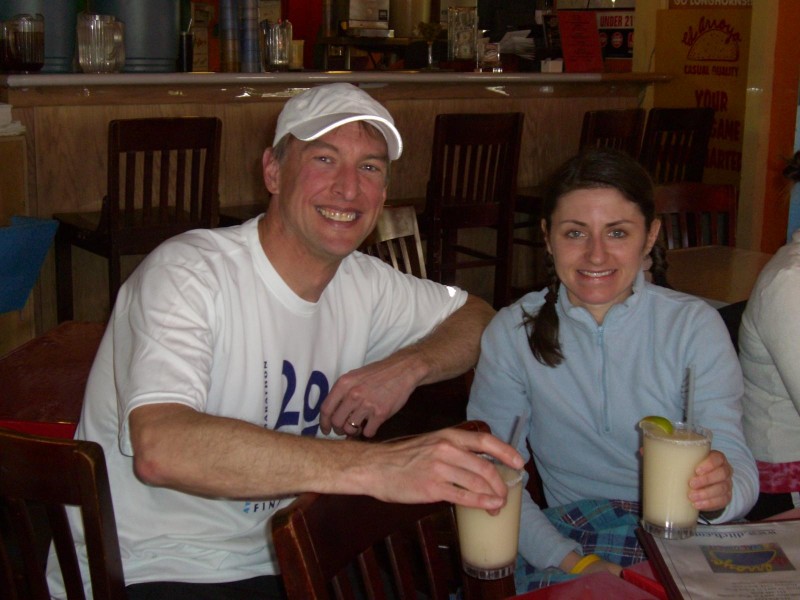
(Frozen margaritas are the best post-marathon recovery drinks. In Austin 2007, where we both had personal records. His still stands.)

Craig's rationale for booking a trip to Sydney just a month ahead from the race is surprisingly rational. In August, Craig had run only two marathons since breaking his ankle in early 2009 by falling on ice, an injury that left him unsure about how long he could continue running and put his grand plan on hold. He participated in the New York Marathon ten months after the injury, a race he describes for obvious reasons as a ``bad experience." Running New York 2010, a year after getting corrective surgery, felt like a turning point, he says, giving him some confidence that he'd be able to continue running . For 2011, he turned his sights to Australia, where he considered Sydney and Gold Coast in July.
``The timing worked out this year for doing Sydney, so I went for it," Craig says.
Two weeks after he booked the flight, Hurricane Irene struck, flooding his basement and leaving him without power for six days.
``That was basically the end of my training for the marathon," he says.
Craig, who started running in junior high school, ran his fastest marathon in Austin in 2007, four years after his first try at the distance at age 45.
``Running was always something I enjoyed but never really pushed myself at it until recently,'' he says.

Craig won't stop after he's done with his grand plan. He just turned 50, entering a new age category, and hopes to improve his time enough to qualify for the Boston Marathon.
In the meantime, for the last continent on the list, Africa, Craig is considering the Kilimanjaro Marathon in Tanzania or South Africa. That's about 8,000 miles away from home.

How far would you, or have you gone, to run a marathon? Runners, you can let me know in the comments section.

Labels: , , , , ,

Wednesday, November 16, 2011

Sub-3 Race Report

On Nov. 6, a runner called Cécile ran her seventh and fastest marathon, breaking 3 hours and finishing 54th woman out of 17,000. It's still hard to believe it was me. I estimate that 10 percent of the accomplishment was physical, the result of an injury-free training. The rest was mental: For 2h59m19, I never gave an inch.

My state of mind while lining up at the start of the New York City marathon alongside 47,000 runners was on The Number 3. I usually prefer to keep my goals fuzzy: there's the target I admit publicly and the time I secretly covet but wouldn't admit under torture. This year there was no room for fuzziness: after running my two previous marathons in 3h01, including Boston 2010, I had no choice but trying to get on the faster side of three. I still couldn't bring myself to say it.
``What's your goal?'' asked a fellow runner at the start, whose own target was a precise 2h58.
``Well, I've run my two previous marathons in 3h01,'' came my vague non-answer.

New York 2012 was my first marathon wearing a Garmin watch that gives me the average pace every mile. I was curious to see whether, and how, it would alter my way of running. I'm the kind of runner who can ``feel'' her pace. At the Pocono Mountain Marathon in May, I ran without any notion of time after the half mark and finished in 3h01 within seconds of the previous year's Boston Marathon. Who needs a clock?

In terms of race strategy, I shamelessly stole that of my friend and fellow runner Tomas, who said on the ferry that led us to the race that he would start at a pace of 6:40 a mile (14.5 km/h) and ``see how far I can go.''
I didn't go very far. I lost time at the overcrowded start while zigzagging around runners. For a mile up on the Verrazano Bridge, I couldn't run as fast as I wanted and my pace was over 7:30. I was so upset that I missed the stunning view on my left and looked angrily at the red helicopter hovering on my right. It became the random object of my pent-up, pointless anger. ``Stupid helicopter,'' I thought, ``it's gonna be a long run.''

 (Traffic jam on Verazzano Bridge: Can you spot me?)

When the coast cleared, I went all out downhill on the bridge, peaking at a Kenyan pace of 5:12 (18.7 km/h) to catch up the lost time. I settled down once on Brooklyn's flat grounds, but not for long. With 24 miles (39 kilometers) to go, I started to have what I will call stomach issues (to spare the details). This would become my second-biggest obsession, topped only by The Number 3, for the rest of race. While obsessing about whether to use the bathroom, I ran, and I ran fast: 40:39 for the 10K. I was flying through Brooklyn at about 6:30 a mile, reaching the runner's high in the couple of miles leading to mile 7, where I knew D. and other friends would cheer me.


(Attempting to fly during the runner's high: ``I wanna break three!")

After I failed to see any of my friends, I crashed hard from the high. I wanted to quit. I wanted to cry. I wanted to get out and take the subway back to the hotel. What's the point of running? I had no excuse to quit, except the fear of failing at my ridiculous, self-imposed goal. Some people get so injured they limp their way to the finish hours after most of the runners are done. They don't quit, and I wouldn't either. One question remained: Do I have time to use the bathroom? They were located about every mile after the water stops. Every mile, I decided I would decide at the next one.

Once I passed the half-marathon mark in a personal record of 1h27m02, there was no turning back. Sub-three hours was within reach if I could avoid slowing down too much in the second half -- by far the most difficult part of the course. I focused on pace, trying to stay in the middle of the road, looking right ahead. The race was really starting now and my stomach was not co-operating. I knew I had to give everything I could. I would not stop.
The half-mile uphill of the Queensboro Bridge at mile 15 took a toll, as expected. I was passed by a short female runner from Denmark in blond pigtail and pink socks, running next to a tall man with bleached blond hair and a black t-shirt that said ``Eat Soy.'' They are partners, I decided; he's taking her under 3 and I'm going with them! A quick check at my watch showed I had slowed to a pace over 8 minutes a mile. My mood collapsed. I wasn't the only one suffering: There was a lot of panting and grunting around me -- and a group sigh of relief when we crested the bridge’s midpoint.

 The roar of the Manhattan crowd that greets runners at the bottom of the bridge is akin to entering a gigantic beehive on hormones. For a short moment, I forgot my watch -- and my stomach -- to plunge into the ocean of screams and voices shouting ``Cécile!” I always write my name on my shirt to get a boost from the crowd. Four years ago, my husband (then-boyfriend) and father were waiting for my mother and me after the bridge, in my old neighborhood. No one was here this year -- my husband was a few blocks away at work, following my progress online, while my parents were in France preparing for the Nice Marathon. But the memory kept me going for a couple of miles. I knew the euphoria would soon fade away and the final struggle begin.

(Staying concentrated with one goal in mind.)

I had trained my mind for what came next. Strong with the experience of 2007, I had rehearsed the final miles in my head during training runs. It goes like this after mile 19: There's a bridge and then the Bronx, for a brief part. The crowd is thinning. The end is nearing. After mile 20, the mind wants to give up and let the body take charge. If the body overrules the mind, you stop and walk in pain (and/or look for a bathroom.)

I stayed focused, still taking a sip of water every two miles to avoid running out of energy at the very end. From mile 23 to 24 is the killer uphill of Fifth Avenue; several runners around me stopped and walked. I had also prepared for it. During my last run on the previous Thursday, I came here to rehearse. I spotted the soy-eating runner and fixated on his back. He's taking me there, I thought.
 A colleague who saw me around mile 24 said I was ``in the zone." Inside the zone was an obsessive -- and desperate -- mind ordering my legs to keep pushing as hard as possible no matter what. It now looked feasible to finish under 3 even if I slowed down to over 7 minutes a mile. But my thoughts were clouded. I doubted. I didn't want to lose my concentration. With 200 yards to go, I still wasn't sure I could do it.

 (Getting ``in the zone'' )

Finishing a marathon 41 seconds under 3 hours doesn't make me a better runner than running in 1 minute above 3 hours -- and it certainly doesn't make me a better person when you consider I spent the entire time highly concentrated on myself. But round numbers have an irresistible appeal.

For those who are curious to know how it feels to cross the finish line under a clock starting with the number 2, my experience may disappoint. I felt utter excitement for a split second before stomach cramps and lower-back pain overruled my joy. I had one question for the person distributing the finishers' medals: ``Where is the bathroom?"
Turns out the bathroom was still two miles away, by which time I didn't want to use it anymore. During the walk to get our belongings back, I saw the Danish runner in pink socks. She finished in 3h01, she said, six weeks after running Berlin in 2h58. I knew she was a sub-3 kind of runner. I still can't believe I am, too.

Labels: , , ,

Thursday, March 4, 2010

Kara Crush

Don't tell my husband. I have a crush on someone else.
It's a romance à la Hollywood. At first, I found the object of my crush annoying. Overtime, my admiration for that person grew. Then came the moment that made me feel close. In the denouement, I let my feelings known. The (happy) End.

My crush is Kara Goucher, the top-ranked American runner, who finished third in her first attempt at a marathon in New York City in 2008. I watched her on television, running right behind the world's champions in a distance that was new to her and being cheered by a public that welcomed back home the Queens-born athlete. On TV, Kara was keeping up with the U.K. champion Paula Radcliffe on the Queensboro Bridge. That image got stuck in my memory, partly because I was there a year earlier, on that same bridge, about to come up First Avenue, where my then boyfriend -- now husband -- and my father were waiting to cheer me. Now there was Kara with her black necklace and black sleeves, looking beautiful after running 16 miles (26 km) at a grueling pace. My husband, like all men who've laid eyes on the good-looking athlete, was smitten. I was annoyed.

 (Kara Goucher at the 2009 Boston Marathon. Author: Stewart Dawson.)

Six months later, Kara was under a lot of pressure at the start of the Boston Marathon. She had graduated from being a surprise third in her New York debut to a favorite in Boston. An entire nation -- or at least its runners -- dreamed of an American victory on Patriot's Day. The last American female winner in Boston was Lisa Larsen Weidenback in 1985, when Kara was 7. When Kara came third, she cried. She was disappointed. But she had started her career on 1,500 meters, 5,000 meters and 10,000 meters, and that day she proved she wasn't a one-time marathon wonder. I was in awe.

I became infatuated after reading the cover story in the March 2010 issue of Runner's World magazine. In it, Kara Goucher candidly talks about her crises of confidence and setbacks, including being beaten by her sister -- who's about four years younger -- at a high-school race and having to walk during her first 10k race. I could relate to her fears and her insecurity. She didn't sound fake in a way a Hollywood actress might say in an interview she's insecure about her body (yeah, right). ``Everyone has their weakness,'' she said in the article. ``Mine is confidence.'' The fact that she has to overcome mental demons makes her an even greater champion. According to the article, she's now taking some time off to start a family. Whenever she comes back, I'll be a fan.

Labels: , , ,

Thursday, November 6, 2008

Faster Than Yannick Noah

My parents beat Yannick Noah, 48, the 1983 winner of the French Open, at the New York City Marathon this year. Too bad the word awesome is overused because it applies to them. My parents are in their early 60s. They inspire awe.


``I'm happy with my time,'' my father, 60, said after the Nov. 2 race, his 16th marathon. He was wearing a navy blue, hooded sweat-shirt with ``France'' written on it. He had a big smile on his face. My father finished in 3h37m45s, his best time since 2004, ranking 45th out of 910 men aged 60 to 64. The previous afternoon, nursing a beer in an Irish pub near Penn Station, my father said he would be disappointed if he ran in more than 3h50 and happy if he could go under 3h45.

``It's not bad, I'm just a bit disappointed because I walked near the end.''
That's my mother, 61, standing next to her husband after the race, wearing the same shirt. She completed her 15th marathon in 3h53m32s, 8th of the 216 women in her category, and shaved 5 minutes off her time at last year's New York marathon. ``I can still scrape off few minutes while being one year older!'' she said. At the pub the previous day, she said she would ``explode with joy'' if she could finish in 3h50.

My parents are unaware they are awesome, not just because of their athletic feat, but because of their modesty and the apparent simplicity with which they tackle such a challenge as a marathon. They don't brag. They don't complain. They don't find excuses when their time is disappointing.

Their secret for doing so well this year, they told me, lay in the preparation. For the first time, they chose a training plan -- a strenuous program for a 3h30 race that included speed work on various distances -- and strictly followed it. They also worked on their core. Another change from previous marathons was that they drank water and Gatorade more regularly and took energy gels during the race.

In my father's case, it helped that he was training during the week with a friend who runs faster than him. In my mother's case, it helped that she retired and had time to train. The plan helped them recover faster too. By Nov. 5, any minor sore muscles they'd had were gone. I suspect most of the soreness was due to the flight back home on Nov. 3, rather than the race.

My father said he tried to keep his pace in the second half. In fact, he ran a bit faster from 35k to 40k (27m33s) than from 30k to 35k (27m37s).
``Trying to keep the same pace, avoiding slowing down -- that's the only way to finish,'' he said. ``It's very tempting to say `I'll just slow down a little bit now and pick up later when I feel better,' but it doesn't work. You never pick up.''
My parents work out all year, not just to prepare their marathons. In the winter, they run and take bi-weekly gym classes -- which include abs, stretching and leg work. They bicycle up mountain passes during the summer. Every year in July, they take a two-week vacation bicycling all day from a hotel to another with a large group of friends. That explains why, when they begin their marathon training, they start off from a good base.


Last Sunday after the race, my father was sitting on a bench on Central Park West, busily texting his running partner, and my mother was looking for something in her bag, when the 6-feet-3 (1m93) Yannick Noah walked by. The former champion, who is now a popular pop singer in our country, had just finished his race in 4h00m33s. By the time I'd told my parents to look up, Noah was already several meters away. ``Yannick! Yannick!,'' my mother screamed. The former tennis player didn't look back. If he had, he would have seen two champions who ran faster than he did.

Labels: , , , , , ,